Open World Wayfinding
Research and prototype of wayfinding in an open world game to help players find and carry out objectives. Taking inspiration from the urban planner, Kevin Lynch's idea of "imageability" or how to make memorable places though distinct spatial elements.
Team: Solo project
Role: Game & level designer, Programming, 3D Artist
Timeline: 16 weeks
Project: Thesis Project 2021, MA Visual Game and Media Design, Det Kongelige Akademi
Supervisor: Alessandro Canossa
Music: Stevie Appleby
Audio: zapsplat.com
Dissertation
Project breakdown
For this thesis project I wanted to learn more about level design for open world games, a diverse and immersive genre, and how to guide a Player with the environment and diegetic tools.
I began the project with these definitions in mind:
Wayfinding - encompasses all of the ways in which people orient themselves in physical space and navigate from place to place.
Level Design - How a space/area in a game is created with a specific objective for a Player to complete.
Diegetic information - is that which exists in the game world space, that is available
to a character, and aids immersion. Examples of this: the map and compass in Firewatch, the RIG suit that acts as a health and stamina bar in Dead Space.

1.Research
Collect information from Urban planning theory and open world games.

2.Prototype
Create a prototype based on research.

3.Playtest
Playtest the prototype and iterate on the findings.
Research

The Image of the City - Kevin Lynch
Lynch studied how people make mental images of cities, or how "imageability" helped make urban spaces more memorable. He broke his theory down into five elements:
1 - Paths
2 - Edges
3 - Districts
4 - Nodes
5 - Landmarks
Using these elements to design spaces could help or hinder Players in their understanding of the game space they are in, which could be really useful in an open world level.
Prototyping - Designing Levels
I focused on two main areas when building a playable prototype, level design and wayfinding tools, which were created in parallel. The level design began as a large open level but technical and time restraints led me to create a larger open world level and two linear levels where the Player can collect objects.I designed the levesl with the "Imageability" elements in mind - creating local and radial landmarks to give the Player an indication of where they were, and also parts of the level that were devoid of any sort of helpful elements, so that the Player would need to depend on the wayfinding to guide them.
Open World


Open World level - Landscape with radial landmarks (seen from many vantage points) and local landmarks (objects that are seen at a closer distance). The scene is lit clearly with daylight. Several nodes, or points where the Player chooses the direction to go. Edges to paths are made of water, which the Player can travel through but at a much slower speed.
Cistern Level

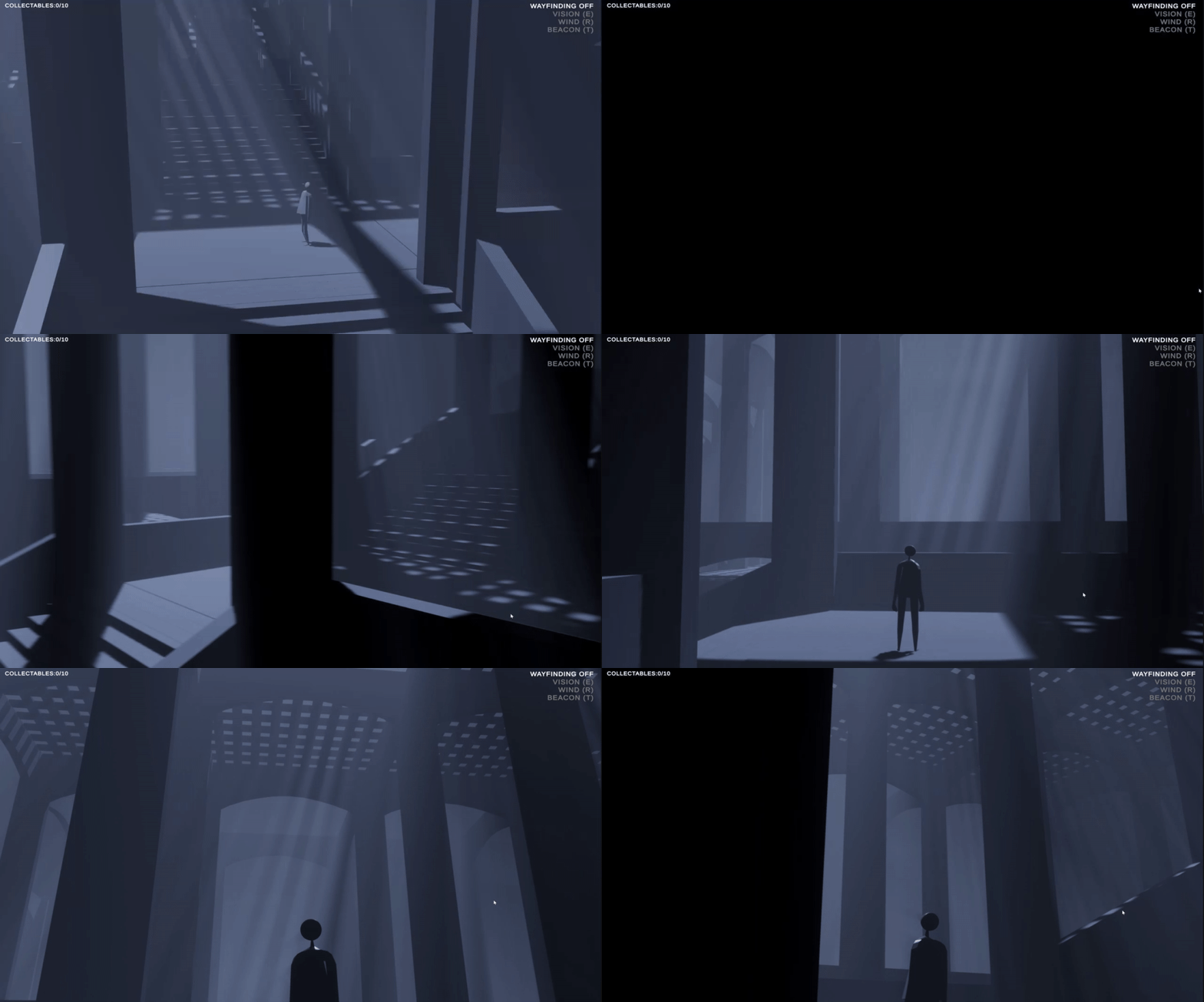
Cistern level - Inspired by Piranesi's "Carceri d´invenzione" and Cisternerne. A heavily structured space that limits the Player's view. No radial landmarks and limited local landmarks. Starkly lit with most of the level steeped in darkness. Linear level with very few nodes.

Chapel Level

Chapel level - Inspired by St Peter's Seminary and UTEC Lima by Grafton Architects. Interior level with larger and smaller spaces that provide more distinction to the Player. Local landmarks that change the rhythm of the building structure. No radial landmarks. Several nodes or paths for the Player to take. Lit in a warm evening sun that gives the Player a clear view of the level.


Prototyping - Wayfinding Tools
For the wayfinding tools, I created a "gym" to build and test how they could be used. I chose to make three wayfinding modes that I could test in the contexts of the three levels I was making. Which wayfinding mode would work best, or would be the most useful to a Player trying to find their way? The modes are:
1 - Vision: an ability to see through obstacles in the environment to check if there is an object to collect behind it. A shader that renders out the material and shows what is behind, like an x-ray, while the screen darkens to obscure the view of the level and highlights the location of the objectives.
2 - Compass: A wind that points in the direction of the closest collectable. As you move, the wind shifts to the next closest collectable. The Player will need to make decisions about the most logical path to take in the direction shown.
3 - Beacon: This wayfinding type is localized to the objective itself and can act as a landmark within the world or to highlight the area the Player needs to reach.
Below are progress videos of the wayfinding in the gyms and the levels.


Playtesting
I recruited eight playtesters to play the prototype and answer a few questions about their experience afterwards. How I conducted the playtests:
- They were held online over discord
- I recorded their gameplay and voice while playing
- Informal interview about experience afterward
From this information, I recorded the number of times each of the wayfinding tools were used, the location of use, and the duration. From this data I could calculate the wayfinding mode that was most frequently used, and the one that was used for the longest for each location. Along with this information I was able to calculate the total time for all wayfinding used in each level, which shows the dependency on using the wayfinding for each player.
Lessons from Playtest


-
Spaces designed using “imagebility” elements are more memorable than those designed without.
-
The distinct elements in a scene that stand out against a repetitive spatial rhythm allows the Player to better remember the space.
-
Landmarks and artifacts within the levels need to be lit in order for them to be memorable and useful to the Player.
-
Both the aesthetics and effectiveness of a wayfinding mode need to be addressed in order for the Player to depend on it. Aim to create immersive wayfinding that the Player can depend on to be correct and work in a way that they understand the information it gives.
Learning outcomes from project
The process of designing and iterating through playtests has helped me focus my work. Feedback from playtesters was valuable but also not as clear as I had hoped - every tester had a completely different preference for the wayfinding tools whereas I thought there would be one clear winner out of the three tools I had made.
I learned more about designing levels; for me I find it helpful to have a real world reference or precedent to inspire the design. Once I have this start point I can alter it to fit how I want the Player to experience the level through lighting, or setting up landmarks that catch attention and guide to the next objective.